How to Form a Texas LLC in 2026: Step-by-Step Guide (With Costs and Tips)

Starting an LLC in Texas is a smart step for many new business owners. A Limited Liability Company, or LLC, helps protect your personal assets by creating a legal separation between you and your business. In most cases, LLCs are also taxed as pass-through entities by default, which means the LLC itself does not pay federal income tax. Instead, the profits and losses pass through to the owners and are reported on their individual tax returns. To form an LLC in Texas, you will need to file a Certificate of Formation with the Texas Secretary of State and pay the $300 state filing fee. Once your LLC is approved, there are a few additional steps that can help you keep your business organized and running smoothly, such as opening a business bank account and preparing an LLC operating agreement. This guide walks you through the key steps to start, manage, and maintain your Texas LLC with confidence.

Table of Contents

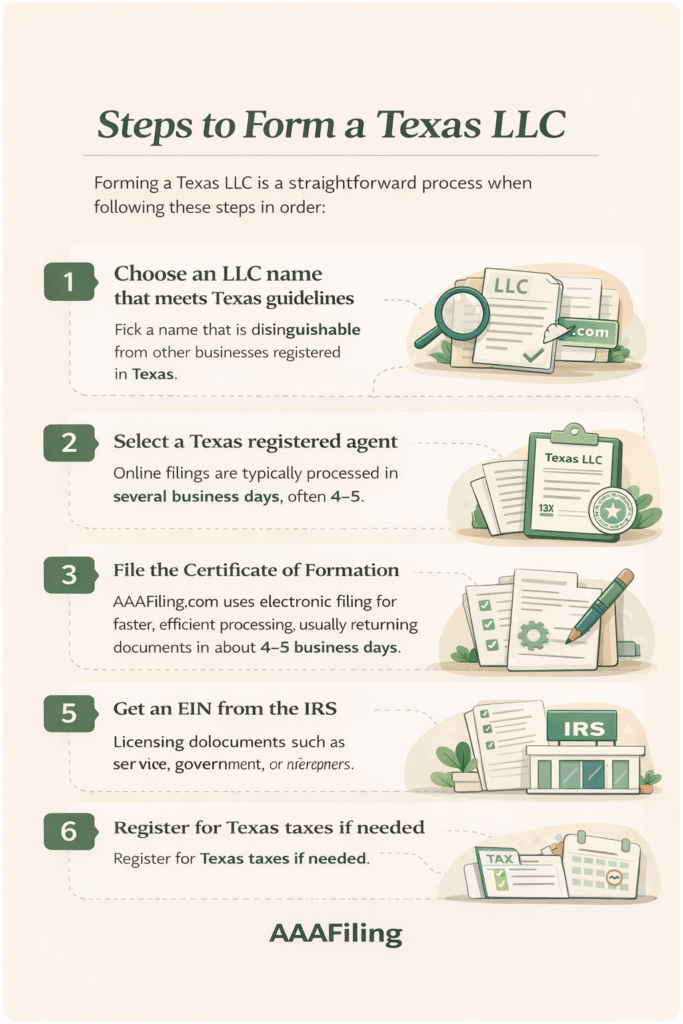
Steps to Form a Texas LLC

Forming a Texas LLC is a straightforward process when you follow the steps in order. The goal is to create a legal business entity with the Texas Secretary of State, choose who will receive official notices, and set up the basics you’ll need to operate properly

Step 1: Choose an LLC name that meets Texas LLC name guidelines

Before you file your Texas Certificate of Formation, you’ll need to choose a name for your LLC. In Texas, you can usually choose almost any name you like, as long as it is not already being used by another business and it follows the state’s naming rules, including those found in the Texas Business Organizations Code.

In general, your LLC name must:

  • Include a designator such as Limited Liability Company, LLC, or L.L.C.
  • Avoid words or abbreviations that could make it seem like your business is something it is not, such as LP or Corporation, suggest a government connection, or use terms that may be restricted for licensed professions, such as Insurance Agency
  • Be distinguishable from the names of other businesses already on record in Texas

If you already have a name in mind, AAAFiling can help check whether it appears to be available in Texas. Just let us know the name you would like to use, and we can search it for you.

Choose the Package that Best fits Your Needs

Starter

$ 39
+State Fees
  • Your LLC/Corp Filed
  • Standard Shipping

Pro

$ 99
+State Fees
  • Starter Package
  • EIN Number
  • Operating Agreement
  • Banking Resolution
  • Electronic LLC/Corp Delivery
  • USPS Priority Shipping
Popular

Premium

$ 199
+State Fees
  • Starter Package
  • Pro Package
  • Custom LLC/Corp Kit
  • Custom LLC/Corp Embossing Stamp
  • Priority Filing Times
  • 48-Hour EIN

Step 2: Select a Texas registered agent

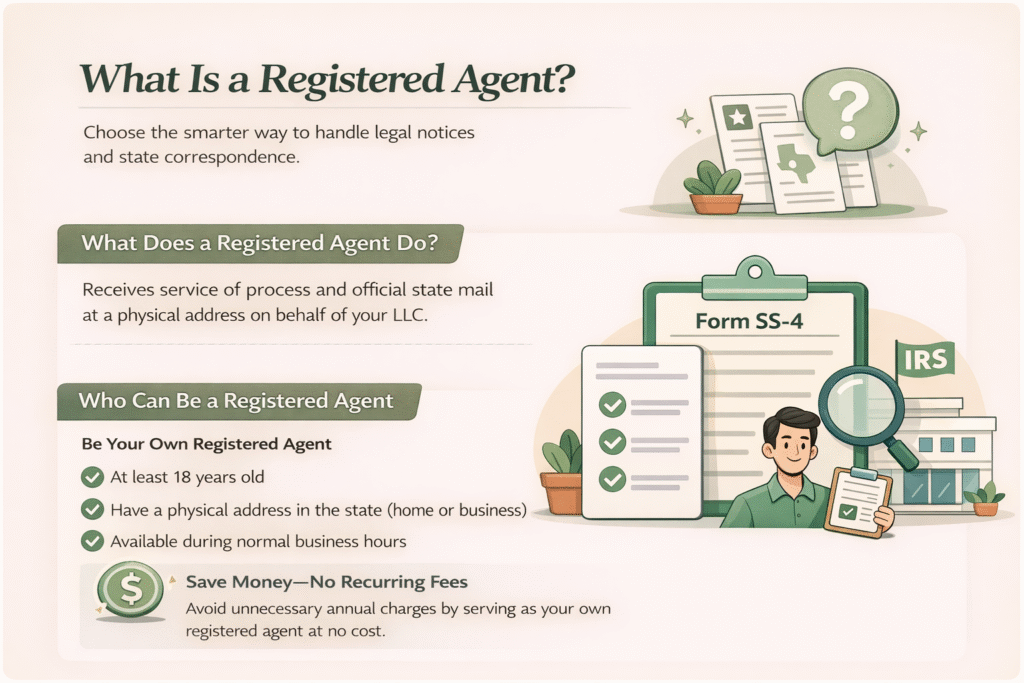
A registered agent is anyone over the age of 18 that maintains an address in the state of formation.  Having said that, you can be the registered agent for free. A Texas registered agent is the person or company responsible for receiving legal notices and service of process on behalf of your business. Texas law requires every LLC to appoint a registered agent.

At a minimum, a Texas registered agent must have a physical street address listed on the public record and be available during regular business hours, Monday through Friday, to accept legal and official mail. That is the basic legal requirement, though many business owners prefer a registered agent service that offers additional support and convenience.

Step 3 File the Certificate of Formation with the Texas Secretary of State

Once you have chosen your business name and secured your domain, the next step is to file your Certificate of Formation with the Texas Secretary of State. The standard state filing fee is $300.

If the filing is submitted electronically and paid by credit card, the total often comes out to around $309 to $315. That total can vary a little depending on the number of name searches performed for your business. Yes, Texas does charge for those name searches as well.

Once the Certificate of Formation is accepted by the state, your LLC is officially formed in Texas.

To complete the filing properly, you will need to provide the information required by the state.

Please note: the information listed on the Certificate of Formation becomes part of the public record. That means if you use your home address on the filing, that address may also become publicly visible.

It is also worth thinking about how the filing is submitted. Paper filings often take several weeks to process. Electronic filing is usually much faster, which is why many business owners prefer it. Instead of waiting three to four weeks, online filings are often processed in about three to five business days, depending on the state’s current workload.

How Do I Submit a Texas Certificate of Formation?

You can file your Certificate of Formation with the Texas Secretary of State online through SOSDirect (an account creation is reaquired), or by mail at:

Secretary of State
P.O. Box 13697
Austin, TX 78711-3697

Note: If you file by mail, you must include the original Certificate of Formation along with a duplicate copy along with a check payable to the Texas Secretary of State. Once the state receives and processes your documents, the duplicate copy will be stamped and returned to you. This method takes about 4 weeks.

If you hire a registered agent service, they can typically receive and organize your legal mail for you. Some services may also scan and upload certain business mail to your online account, which can make it easier to stay on top of important documents.

If you expect to receive regular business mail and need a Texas business address, you may also want to look into mail forwarding or a virtual office option. This can be especially helpful in Texas, where the state may review the address you provide and may reject addresses that appear to be mailboxes rather than a true business address. Because of that, a virtual business address may be a more practical option than renting a mailbox and trying to use it as your company address.

Step 4: Create an LLC Operating Agreement (recommended)

An LLC operating agreement is essentially the internal rulebook for your business. It explains how the company will be run, including things like financial contributions, management responsibilities, voting rights, ownership interests, and the roles of each member.

Texas does not require you to submit a written operating agreement to the state. In fact, even an oral agreement can be considered valid. Still, having a written operating agreement is strongly recommended because it gives you something clear and concrete to rely on if questions or disagreements come up later.

It can also be very helpful when opening a business bank account, since many banks will ask to see an operating agreement before allowing an LLC account to be opened.

Just as importantly, a written operating agreement can help reinforce your LLC’s limited liability protection. Without one, a court may be more likely to treat the business like a sole proprietorship or partnership rather than as a separate legal entity. That can create unnecessary risk.

Another reason this document matters is that, without your own agreement in place, your LLC will generally be governed by Texas’s default LLC rules rather than the rules you and your members actually want to follow.

One important thing to understand is that this document is not filed with the State of Texas. It is for your own internal records. Think of it as the company’s private instruction manual.

If your LLC has more than one member, an operating agreement becomes even more useful because it can clearly spell out who has authority to do what. For example, it can describe who is allowed to make purchases, sign contracts, rent equipment, manage certain business decisions, or take other actions on behalf of the company.

In simple terms, if something is important to the way your business operates, it can usually be addressed in the operating agreement. The goal is to create clear rules that fit your company, keep everyone on the same page, and help the business run smoothly.

Step 5: Get an EIN from the IRS

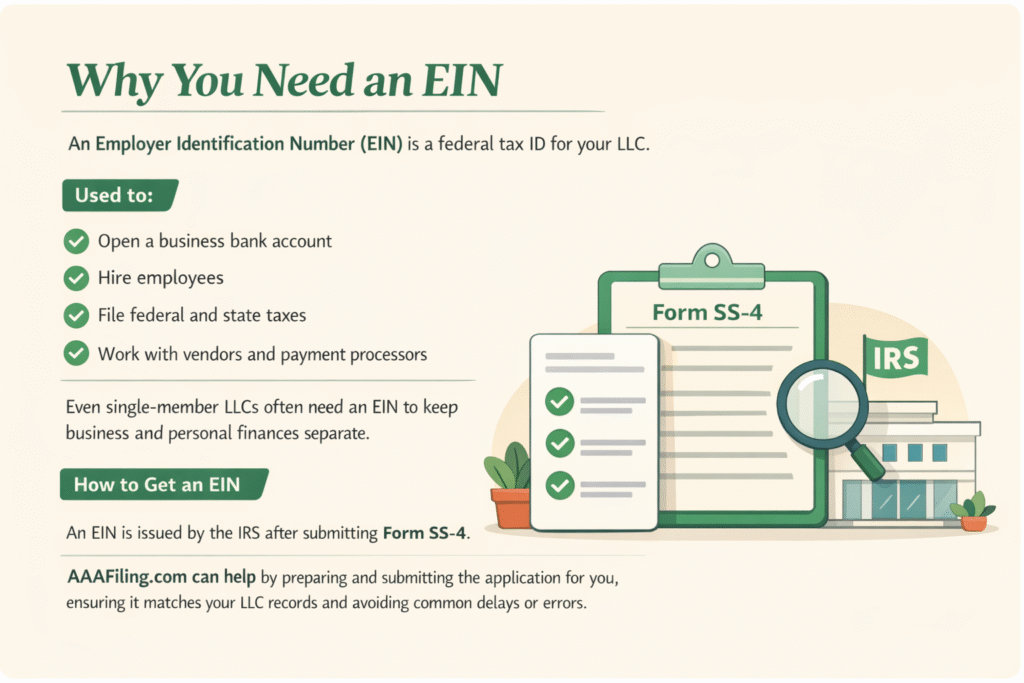
An Employer Identification Number (EIN) is a number issued by the IRS for your business. You can think of it as a business version of a Social Security Number. Just like a Social Security Number is used to identify an individual, an EIN is used to identify a business.

Any LLC with employees, or with more than one member, is generally required to obtain an EIN. Even if you have a single-member LLC with no employees, you will usually still want one because most banks require an EIN before opening a business bank account. Without an EIN, you may end up having to use your personal Social Security Number for certain business-related purposes.


The good news is that the IRS does not charge a fee for an EIN, and many business owners can get one quickly by applying online. If you do not have a Social Security Number, the process is a little different, and you may need to submit a paper Form SS-4 instead.

Once you receive your EIN, be sure to keep a copy of it with your business records. Banks will commonly ask for your EIN confirmation along with your formation documents when you open a business bank account.

Step 6: Open Your Business Bank Account

Keeping your business finances separate from your personal finances is one of the most important things you can do after forming your LLC. If you mix the two, it can weaken the legal separation between you and your company. In some situations, that could make it easier for a court to hold you personally responsible for debts or judgments against the LLC.

The best way to protect that separation is to open a dedicated business bank account and use it only for business income and expenses.

Banks may have slightly different requirements, but in many cases, you will be asked to bring the following:

  • your Texas Certificate of Formation
  • your LLC Operating Agreement
  • your EIN confirmation from the IRS
  • a Resolution to Open a Bank Account (Sometimes required)
  • Your ID

Opening a business bank account does not have to be difficult. Many banks now offer business checking options with low opening requirements, and some even allow you to start the process online. In many cases, all you need are your formation documents, your EIN, your operating agreement, your identification, and the opening deposit required by the bank.

If you open the account in person, the process is often fairly quick. If you open it online, it can be even more convenient. Either way, having a separate business account helps keep your records cleaner, makes bookkeeping easier, and supports the legal structure of your LLC.

Step 7: Register for Texas taxes if needed

After your LLC is formed, you will need to keep up with certain ongoing state requirements. In Texas, that generally includes filing an annual Franchise Tax Report with the Texas Comptroller of Public Accounts. This report is typically due each year on May 15 and can usually be filed online or by mail.

The report includes information such as your LLC’s revenue and business classification, which the state uses to determine whether your business owes franchise tax.

The good news is that many Texas LLCs do not actually end up owing franchise tax. For many small businesses, revenue falls below the threshold where tax is due, which is one reason Texas is often seen as a business-friendly state.

Texas is also attractive to many business owners because it does not impose a personal state income tax. That can make Texas less expensive to operate in over time compared with some other states, even though the initial LLC filing cost is higher than average.

That said, tax rules can change, and every business situation is different. For anything specific to your company’s taxes, it is always a good idea to speak with a qualified tax professional.

Step 8: Keep your LLC in good standing

After formation, most LLC owners focus on staying organized: keeping your registered agent active, maintaining accurate company records, and meeting any required state filings or tax obligations. Staying in good standing helps protect the LLC’s liability shield and keeps your business compliant.

Tips for Filing a Texas LLC on a Budget

If you are trying to keep formation costs low, a few simple decisions can make a real difference.

Choose your business name carefully before filing.
If you rush the naming process and need to make changes later, it can cost you time and create extra work.

Be thoughtful about the address you use.
Texas filings become part of the public record, so if you use your home address, that information may become public. That is something many business owners do not think about until after filing.

Do the free steps yourself when possible.
For example, getting an EIN from the IRS is something many business owners can handle without paying extra for help.

Only pay for convenience where it truly matters.
Some people are comfortable handling paperwork on their own. Others would rather pay a small fee to save time and avoid mistakes. Either approach can make sense, as long as you know what you are paying for.

Open your business bank account early.
This helps you keep business and personal money separate right from the start, which is one of the simplest ways to treat the LLC like a real business from day one.

The Cheapest Way to Start an LLC in Texas Is Not Always the Best Way

There is a difference between filing cheaply and filing wisely.

Yes, many people want the lowest possible price, and that makes sense. But the goal should not just be to spend the least amount of money. The goal should be to get the LLC set up correctly, protect your information where possible, and make sure the business is ready to operate once the filing is done.

Sometimes the cheapest route is doing everything yourself. Other times, paying a small amount for help is worth it if it saves you from delays, confusion, or mistakes. The key is knowing the difference between useful help and unnecessary upsells.

Common Mistakes New Business Owners Make When Starting an LLC or Corporation

After helping form thousands of LLCs and corporations over the years, one thing becomes very clear: most new business owners are not making careless mistakes. Usually it is the opposite. They care a lot, they are excited, and they are trying to do everything right. A lot of the mistakes people make come from overthinking, overpreparing, or spending money too early in the process.

One of the most common mistakes is spending money on branding before the business name is actually confirmed. People will order business cards, buy a domain name, have shirts printed, or start building a website because they believe the name is available. Then when it comes time to actually file the LLC or corporation, they find out the name has already been taken. That is a frustrating and expensive mistake. It is usually better to get the formation paperwork handled first, confirm the name is truly available, and then start spending money on logos, cards, websites, and promotional materials.

Another very common issue is renting office space too early. A lot of businesses can start from home, especially in the beginning. When you are just getting off the ground, your money usually needs to go toward things that help you actually operate the business, such as supplies, insurance, equipment, advertising, or other real startup needs. Rent can become a heavy monthly burden before the business is even producing steady income.

People also often pay for things they may not need to pay for at all. Operating agreements, bylaws, basic business plans, and certain startup documents can often be created very affordably or even for free now. The same goes for registered agent service. Many people do not realize that, in many cases, they can serve as their own registered agent at no cost, as long as they meet their state’s requirements. That alone can save money right away.

Another mistake is paying too much for the filing itself. Some companies make the process look inexpensive at first, but the total ends up including subscriptions, recurring charges, or add-ons that are not really necessary. Filing your company should not feel like signing up for a long-term membership. In many cases, the formation itself is a one-time process.

There is also a bigger reality check that many people need to think through before launching. Starting a business is not just about getting the LLC or corporation filed, setting up a phone number, and printing some cards. It takes real time and attention to run a business properly. If you are starting a side business while working full-time, it is worth asking yourself whether you truly have the time to return calls, help customers, follow through, and build trust. A business can have all the right pieces on paper and still struggle if there is not enough time behind it.

That said, there are smart ways to make a side business more manageable. For example, an answering service can be a very practical tool. It is often affordable, a real person can answer the phone, and messages can be passed along so you can return calls when you are available. That can create a much better first impression than missed calls going unanswered all day.

One last mistake worth mentioning is buying email lists. This sounds appealing to many new business owners because it feels like a shortcut to getting customers. But in reality, unsolicited emails are usually ignored, deleted, or sent straight to spam. Most people do not respond warmly to a random sales message from a company they have never heard of. In many cases, that money would be better spent on building a real website, improving customer service, or doing something that creates genuine trust.

In the beginning, the smartest approach is usually the simplest one: form the business properly, keep costs lean, avoid spending money too early, and focus on what actually helps you serve customers well. That may not be the flashy answer, but it is the one that tends to work best over time.

Author Bio:

This section was written by Jeremy Schwarz, CEO of AAAFiling.com. Jeremy personally started this website back in 2009 and has filed over 2000 LLCs and corporations in the state of Texas over the last 17 years. He has talked with thousands of new business owners and has more experience filing new businesses in the state of Texas than almost anyone in the country.


AAAFiling.com is a document filing service which is not staffed by attorneys, and thus does not provide legal advice of any kind. Additionally, the information contained on this website is strictly for informational purposes and moreover is not intended to provide, substitute, supplement or serve any legal purpose. Additionally, should you require legal advice or if you are uncertain about any information contained on this site, please contact a licensed attorney.

CONTACT US

If you have any questions, our knowledgeable representatives will make ordering easy. We have filed thousands of LLCs since 2009 and have an A rating with the BBB and 4.7 stars on Trustpilot. Whateve questions you have we can help.